
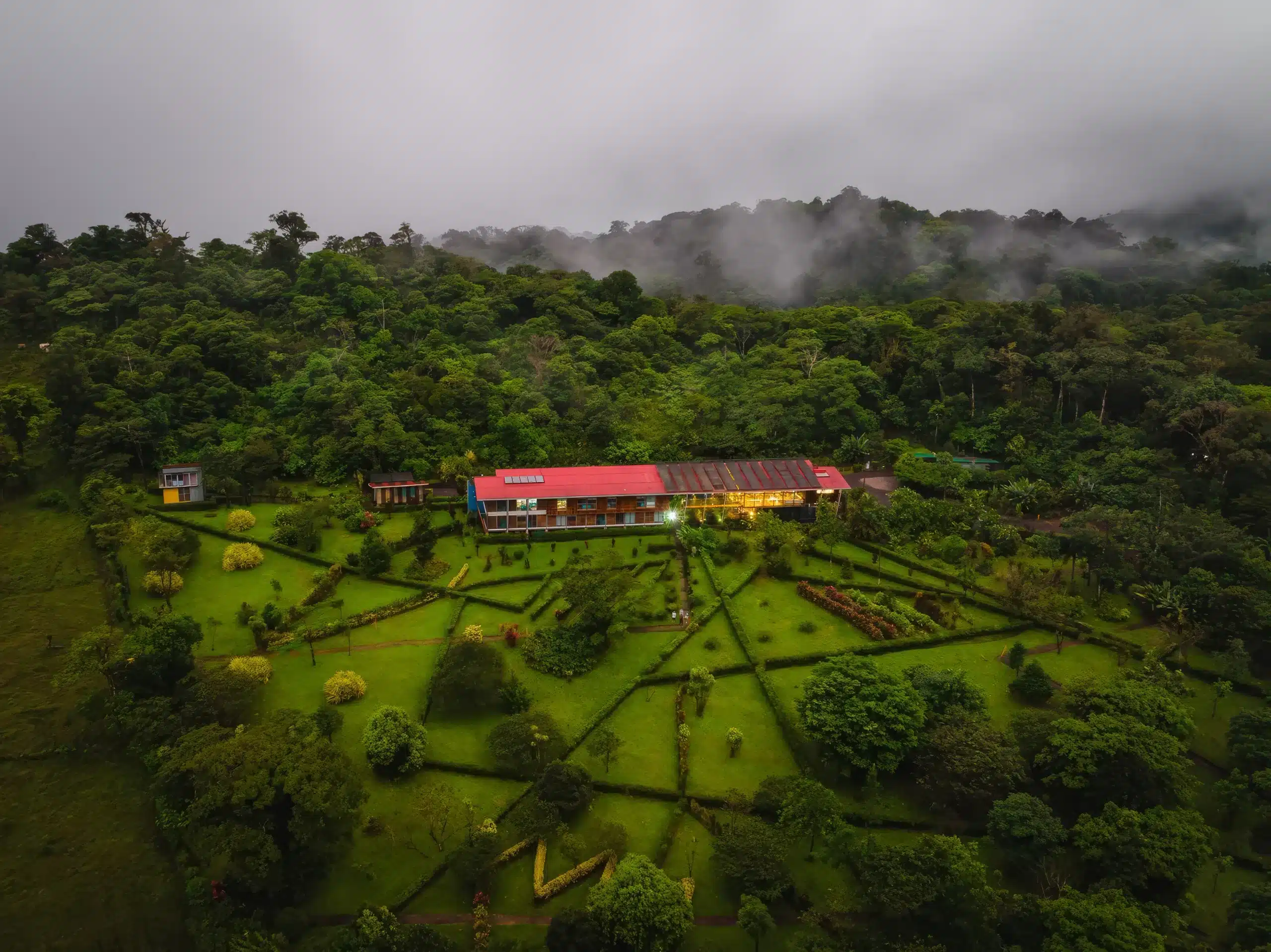
Yes, they exist, and yes, they change hands. Not often, and almost never through a listing. Costa Rica’s private cloud forest reserves were mostly assembled by individuals and families across the 1980s and 1990s, before the land became unbuyable at scale, and they move when a generation changes rather than when a market does.
This is what a serious buyer looks at, in the order that matters.
What you are actually buying
Four things arrive together, and only one of them appears on a profit and loss statement.
The land. Contiguous private forest at altitude, usually assembled parcel by parcel. Its scarcity is absolute: the country is not making more land between its protected areas, and the parcels that complete a biological corridor almost never trade.
The position. Real estate investors talk about location. Conservation investors talk about position. When private forest connects two protected areas, its ecological value multiplies, because the wildlife using it treats the property as part of a system far larger than its boundaries. Species density on such land reflects the whole corridor, not just the parcel.
The science. A reserve that hands you classified species lists, a herbarium, published research and long term monitoring records is handing you a verified impact baseline. For a fund reporting to LPs or a board, that documentation is the difference between marketing language and measurable conservation. Reserves where new species have been described sit at the top of this hierarchy.
The operating layer. Most reserves carry a small lodge. Underwrite it honestly: it will rarely justify the purchase price alone, and it does not need to. Its job is to fund stewardship, host researchers and give the mission a public face.
Start with title, not with the financials
This is the part outside buyers get wrong most often, and it costs the most.
Costa Rican property runs on a national registry, and mature reserves were often assembled over thirty years. That history usually signals a serious steward. It is not a substitute for registered title, and the two are easy to confuse.
The first question is not whether title is clean. It is whether title exists. Land in the conservation belt was frequently held by possession long before anyone registered it, and the survey plans drawn for those parcels are often marked para informacion posesoria, meaning they were prepared to perfect a possessory claim rather than to record an existing one. Where that process completed there are inscribed fincas and ordinary diligence applies. Where it did not, what the seller holds is possession, and what you can acquire is a different and weaker thing.
An estudio registral on every parcel answers this in days and costs almost nothing. Ask for it before you ask for the accounts. Then confirm every boundary, every annotation, and how the pieces fit into one holding.
What the forest regime allows, and what it does not
Conservation land in Costa Rica frequently carries legal restrictions that a buyer inherits whether or not anyone mentions them.
Parcels inside a declared protective zone can be subject to the forest regime by law rather than by choice. Individual survey plans can carry their own restrictions, limiting use to protection of soils, water, flora and fauna. Article 33 of the Forestry Law 7575 sets protection areas around springs and watercourses that cannot be built on at all.
Read this both ways. It is permanence you inherit for free, which is precisely what a conservation buyer wants and cannot manufacture. It is also the reason a development plan may not survive contact with the file. Anyone promising you expansion on a reserve should be able to say which parcel it happens on and what that parcel’s plano permits.
What the land earns
No single layer carries a reserve. Together, run competently, they cover operations and fund the science.
Low volume hospitality is the anchor, and its economics invert the normal kind: the tiny room count is a feature, because scarcity plus authenticity commands rates that volume properties cannot reach. Around it sit the research economy, universities and visiting scientists who need functioning field stations in primary forest; education programmes; and specialist guiding, which converts biodiversity into daily revenue at almost no capital cost.
Then there are environmental service payments, which deserve their own paragraph because they are widely misunderstood.
Costa Rica has paid landowners for forest protection since 1996, through FONAFIFO under the Forestry Law 7575, at rates published annually rather than negotiated. For the 2025 to 2026 programme year, forest protection pays 105,000 colones per hectare across a five year contract, rising to 185,000 colones where the land also qualifies on water resource protection or as a high biodiversity site. Qualifying forest is separately exempt from property tax and asset tax under article 23 of the same law.
Two limits decide what that is worth on any given property. Enrolment is capped at 300 hectares per owner, so a larger holding is only ever partly covered. And enrolment cedes the greenhouse gas rights to the state for the term of the contract, which means state payments and an independent carbon position are alternatives rather than additions. Any model that stacks both is counting the same tonne twice.
About the carbon
The stored carbon in a mature cloud forest is real and very large. Turning it into a tradable credit is the hard part.
A credit is issued for carbon that would not otherwise have been stored. A forest protected by the same family for thirty years, under no credible threat of clearance, struggles to demonstrate that additionality. Peer reviewed work published in 2026 found avoided deforestation projects claiming, in aggregate, roughly ten times more benefit than independent estimates support, and that class of credit has repriced accordingly.
Where the carbon does count is on a balance sheet rather than in a revenue line. For a buyer with its own emissions to account for, holding a large permanent pool has a logic that has nothing to do with selling credits. Insetting, not offsetting.
Writing permanence in
Costa Rica offers real tools for buyers who want the conservation to outlive them: private wildlife refuge status, easements held with conservation organisations, deed covenants, and the state payments programme. None are automatic and all are achievable with counsel. Layer them at acquisition, when intent is fresh and the founders can bless the design.
One more thing belongs in the acquisition plan. A reserve is only as protected as the people walking it, and resident guides and biologists hold decades of knowledge no data room contains. The best acquisitions arrive with continuity agreements sketched before closing.
Frequently asked
How do these properties come to market? Through generational transitions, handled discreetly through advisors rather than listings. If you are waiting to see one advertised, you are waiting for the wrong signal.
How long does due diligence take? For a well documented reserve with an organised data room, 60 to 90 days is realistic. Title questions are what extend it.
Can a foreign buyer own the land outright? Costa Rica places foreign owners on equal legal footing with citizens for titled land, which is one reason the country dominates this asset class in the region.
Can corridor land be developed? Lightly and thoughtfully, typically around existing footprints. Its highest value is precisely that it never will be intensively developed.
What kills these deals? Rarely the forest. Usually title that turns out to be possession, mixed family financials that were never normalised, or a buyer who treats the family as a counterparty instead of a founder. All three are avoidable.
A private cloud forest reserve with an operating boutique lodge is currently represented by CHN Hospitality Partners under confidential mandate, Ref. CHN-022. Qualified investors receive full information after a signed NDA and buyer registration. Write to tara@invest-costarica.com or daniel@invest-costarica.com.
